Where it came from
The history of El Niño
El Niño was noticed long before anyone could explain it. Fishermen gave it a name, a British scientist in India found half of it, and a Norwegian-born meteorologist put the two halves together.
Named by fishermen, for Christmas
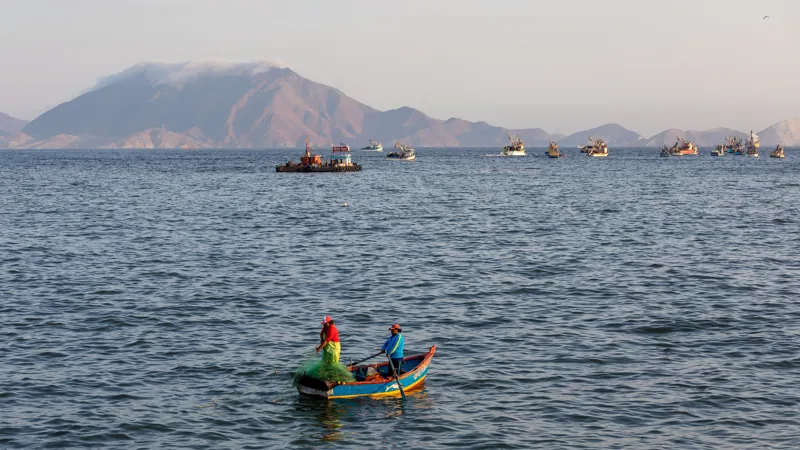
The first people to notice El Niño were those who depended on the sea. NOAA says that in the 1600s Peruvian fishermen working off the coast of South America first recognised the phenomenon “when changing ocean currents caused a drastic drop in their catch.” [NOAA] They named it El Niño, “Little Boy” in Spanish, because it typically arrived around Christmas. [NOAA]
The Christmas link appears in every official telling. NOAA’s Pacific Marine Environmental Laboratory says El Niño means “The Little Boy or Christ child in Spanish,” and that the name was used “for the tendency of the phenomenon to arrive around Christmas.” [NOAA PMEL] The Royal Meteorological Society says Peruvian fishermen and sailors noticed a warm current around Christmas and named it El Niño, the “Christ Child”. [Royal Meteorological Society]
The original meaning was smaller than today’s. NOAA’s Climate Prediction Center says El Niño “originally referred to an annual warming of sea-surface temperatures along the west coast of tropical South America.” [NOAA Climate Prediction Center] Today the name covers a warming across the central and east-central equatorial Pacific that changes weather around the world. [NOAA Climate Prediction Center]
The 1600s, or “around Christmas”? NOAA’s main El Niño page dates the fishermen’s discovery to the 1600s. [NOAA] The PMEL and Royal Meteorological Society pages give no date, and the WMO says the name came “likely because it typically became noticeable around Christmas.” [NOAA PMEL] [Royal Meteorological Society] [WMO] We quote each one as written.
Older than people
El Niño did not start when it was named. NOAA says climate records of El Niño go back millions of years, with evidence of the cycle found in ice cores, deep-sea muds, coral, caves and tree rings. [NOAA] PMEL adds that the chemistry of ancient tropical Pacific coral skeletons shows ENSO has been happening for at least 125,000 years, across the last ice age cycle, when the climate was cooler and very different from today’s. [NOAA PMEL]
Thousands, 125,000 or millions? The Met Office says proxy evidence such as coral growth rates shows ENSO “has been active for thousands of years.” [Met Office] PMEL says coral chemistry shows at least 125,000 years, and NOAA says records go back millions of years across several kinds of evidence. [NOAA PMEL] [NOAA] Each is a “for at least” statement from different evidence, so they do not contradict each other, but they are not the same number.
Sir Gilbert Walker and the see-saw in the air
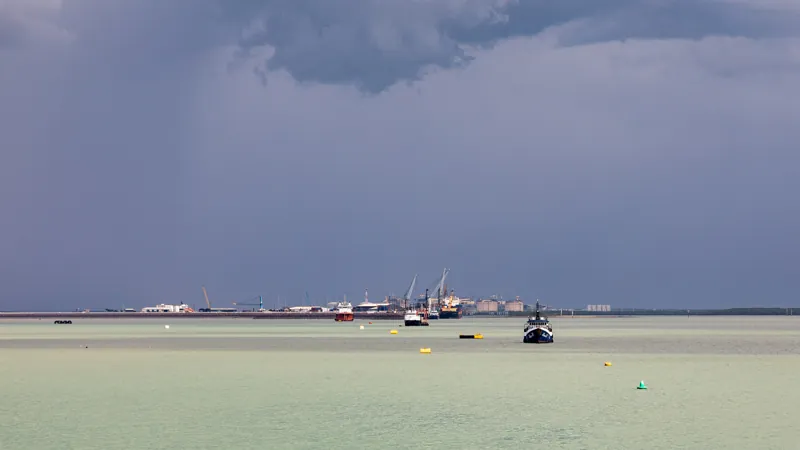
The second half of the story is in the atmosphere. Climate.gov says that Sir Gilbert Walker discovered the “Southern Oscillation,” large-scale changes in sea level pressure across Indonesia and the tropical Pacific. [NOAA Climate.gov] The Climate Prediction Center describes it as fluctuations in air pressure between the western and eastern tropical Pacific that accompany the ocean changes. [NOAA Climate Prediction Center]
It is still measured with two weather stations. The Southern Oscillation Index is calculated from the difference in surface air pressure between Tahiti in French Polynesia and Darwin in Australia, chosen because of their long data records. [NOAA Climate Prediction Center] During El Niño episodes the index has a large negative value, because pressure is lower than average at Tahiti and higher at Darwin; during La Niña the pattern reverses. [NOAA Climate Prediction Center]
Walker’s name also lives on in the sky. The Walker Circulation is the great atmospheric loop over the tropics: air flows east to west near the surface, west to east higher up, rising in the west and sinking in the east. [NOAA Climate.gov] See how El Niño works.
Jacob Bjerknes puts it together
For decades the warm water and the pressure see-saw were studied separately. Climate.gov says it was not until the late 1960s that Jacob Bjerknes and others realised the changes in the ocean and the atmosphere were connected, and that this is when the hybrid term ENSO was born. [NOAA Climate.gov] ENSO stands for El Niño/Southern Oscillation. [NOAA Climate Prediction Center]
In that combined picture, El Niño is the warm phase of the cycle and La Niña the cool phase; the Climate Prediction Center calls them a Pacific warm episode and a Pacific cold episode. [NOAA Climate Prediction Center] Before La Niña was even recognised, Climate.gov notes, South American fishermen had noticed the coastal warm-up that came every so often around Christmas. [NOAA Climate.gov]
Buoys across the Pacific
The modern era of watching El Niño began at sea. PMEL’s chronology records its first successful moored equatorial current-meter buoy in 1976 and the first real-time transmission of air and sea temperature from a mooring at 0°, 110°W in 1980. [NOAA PMEL] The TAO array was then built over ten years, from 1985 to 1994, and by December 1994 it was complete, with 64 ATLAS moorings and five current-meter moorings. [NOAA PMEL] [NOAA PMEL]
The story continues on watching El Niño, and the biggest events since 1950 are on the big ones.
Enjoyed a dated official advisory, unblended thresholds, and a careful look at chances rather than guarantees?
No pop-ups. No intrusive advertising. Just interesting stuff. A little support helps the next climates.im site get built.